
Petrol Relief Scheme 2026: Get Rs100 Per Liter Petrol Subsidy in Pakistan:
Fuel has turned into the heaviest line in most household budgets this year. If you ride a motorcycle to work, drive a rickshaw all day, or run a small 800cc car, you already know that filling the tank now costs close to double what it did in February.
The federal government has finally responded with a targeted petrol subsidy. Under the new petrol relief scheme, eligible riders and drivers pay Rs100 less per litre on a fixed monthly fuel quota. Registration is completely free, it runs entirely over SMS, and the whole process takes about two minutes.
This guide explains everything in plain language. You will learn who qualifies for the fuel relief scheme, exactly what to type in your registration message, how the fuel token works at the pump, how much money you actually save each month, and which mistakes get applications rejected. Every figure here is traced back to the Prime Minister’s Office and the Ministry of Information Technology and Telecommunication, so you are not depending on a forwarded WhatsApp screenshot.
Petrol Relief Scheme SMS Generator
Enter whatever details you have. We format the message exactly as the system expects it, then open your phone's messaging app with 9771 and the full text already filled in. You press send yourself.
13 digits. Type it any way you like, dashes are stripped for you.
Spaces and dashes are removed automatically.
Pick the province printed on your registration book, not where you live now.
Type the digits only, for example 10092026. Slashes appear as you go.
To 9771
REG
Start typing to build your message.
You appear to be on a computer. Copy the message above, then send it from the phone whose SIM is registered on your own CNIC.
Your details stay in this browser. Nothing is stored, saved or sent to us. Send the message from a SIM registered on your own CNIC, otherwise verification will fail.
What is the PM petrol relief scheme?
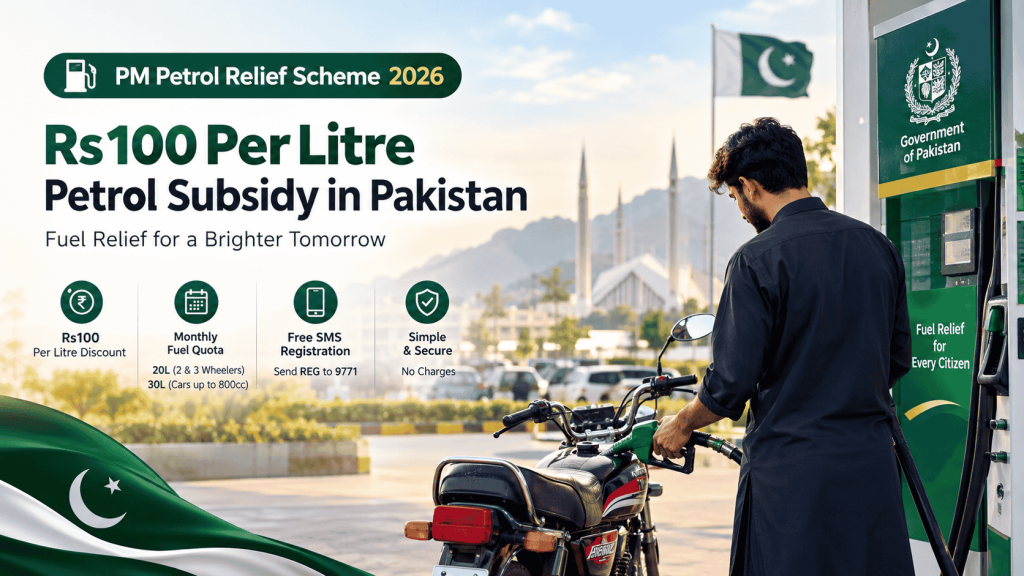
The PM petrol relief scheme is a targeted fuel subsidy that gives Rs100 per liter off petrol to owners of motorcycles, rickshaws, Qingqis and cars up to 800cc. Two and three-wheelers receive the discount on 20 liters per month, while small cars receive it on 30 liters per month. Registration happens by sending an SMS to 9771.
Prime Minister Shehbaz Sharif announced the scheme on 13 September 2026 as global oil prices climbed sharply. Instead of cutting the pump rate for everybody, the government chose a quota-based petrol discount scheme that reaches small vehicle users first.
The reasoning behind that choice matters. A blanket price cut would drain the national exchequer far faster, and most of the benefit would flow to large engines, luxury cars and heavy transport. A quota-based fuel subsidy, by contrast, directs the relief towards daily commuters, delivery riders, rickshaw drivers and low-income households who feel every single rupee at the petrol pump.
According to the statement issued by the Prime Minister’s Office, the government fully understands the burden that rising oil prices place on ordinary people, and it will not leave the public alone during this difficult period. The Ministry of IT built the delivery system together with NADRA, the provincial transport departments and the country’s telecom operators.
Petrol relief scheme 2026 at a glance
Before we get into the detail, here is the whole scheme summarised in one table. Bookmark this section if you only need the headline facts.
PM Petrol Relief Scheme
Key Facts
| Detail | Information |
|---|---|
| Scheme name | PM Petrol Relief Scheme / Special Fuel Relief Scheme |
| Announced by | Prime Minister Shehbaz Sharif |
| Announcement date | 13 September 2026 |
| Discount | Rs 100 per liter on petrol |
| Quota for bikes, rickshaws, Qingqis | 20 liters per month |
| Quota for cars up to 800cc | 30 liters per month |
| Registration method | SMS to 9771 |
| Registration keyword | REG |
| Fuel token keyword | TOK |
| Registration fee | Free No charge |
| Verification partners | NADRA and provincial excise and transport departments |
| Islamabad start | Midnight between 14 and 15 September 2026 |
| Rest of Pakistan start | Midnight between 16 and 17 September 2026 |
| Applies to diesel? | No, petrol only |
Why this fuel subsidy works differently from earlier ones
Pakistan has attempted fuel and utility subsidies before, and leakage has always been the weak spot. Manual eligibility checks moved slowly, were easy to manipulate, and frequently left the intended beneficiary out of the picture entirely.
This time, however, the entire verification runs against databases that already exist. Your identity gets checked against NADRA records, while your vehicle gets checked against provincial excise and transport records. Because the system matches those records automatically, there is no counter to visit, no form to fill and no file to submit.
Two hard rules keep the scheme tight. One CNIC can register only one vehicle, and one vehicle can be linked to only one CNIC. Consequently, the two most common routes to subsidy abuse are closed off from day one.
Who is eligible for the petrol relief scheme?
Eligibility depends on your vehicle category rather than your income. If your vehicle sits in one of the two groups below, and the registration book carries your own name, then you can apply today.
Category 1: Motorcycles, rickshaws and Qingqis
This group covers motorcycles, auto rickshaws, motorcycle rickshaws, chingchis, Qingqis and similar two and three-wheeled vehicles. Eligible users get Rs100 per liter relief on a monthly petrol quota of 20 liters.
Delivery riders, students, office commuters and rickshaw drivers therefore make up the single largest beneficiary group under this scheme. Given that Pakistan has tens of millions of registered motorcycles, this category carries most of the scheme’s social weight.
Category 2: Cars with engines up to 800cc
Small cars with an engine capacity of up to 800cc qualify for the same Rs100 per liter petrol discount, though on a larger monthly quota of 30 liters. Suzuki Mehran, Suzuki Alto, Suzuki Bolan, Daihatsu Mira and comparable 800cc models fall inside this bracket.
Do check your exact engine capacity before you assume you qualify. Several popular models are sold in both 660cc and 1000cc variants, and only the smaller variant makes the cut.
Who does not qualify for the fuel subsidy
- Cars above 800cc, which includes 1000cc, 1300cc and larger engines
- Diesel vehicles of any kind, because the relief covers petrol only
- Commercial vans, trucks, buses, tractors and heavy transport
- Vehicles still registered in someone else’s name, unless you transfer ownership first
- Applicants using a SIM that is not issued on their own CNIC
- Unregistered vehicles with no record in the provincial excise database
Quick eligibility checklist
Run through these five points before you send anything. If you can tick all five, your registration should go through on the first attempt.
- My vehicle is a bike, rickshaw, Qingqi or a car up to 800cc
- The vehicle runs on petrol, not diesel
- The registration book shows my own name and my own CNIC
- My mobile SIM is registered on the same CNIC
- I have my registration number and registration date in front of me
If your bike is still registered to the previous owner, sort that out before applying. You can confirm the current registered owner within seconds through our MTMIS Punjab online vehicle verification tool, and if a transfer is due, the Motor Vehicle Tax Calculator shows you what the transfer and token tax will cost.
How much will you actually save on petrol?
The headline number sounds larger than the real monthly benefit, so it helps to work through the arithmetic properly. Remember that the Rs100 discount applies only inside your quota, never to every liter you buy.
PM Petrol Relief Scheme
Savings by Vehicle Type
| Vehicle type | Monthly quota | Discount / liter | Max monthly saving | Yearly saving |
|---|---|---|---|---|
| Motorcycle, rickshaw, Qingqi | 20 liters | Rs 100 | Rs 2,000 | Rs 24,000/ year |
| Car up to 800cc | 30 liters | Rs 100 | Rs 3,000 | Rs 36,000/ year |
At the petrol price of Rs375.82 per liter announced on Friday 11 September 2026, an eligible buyer pays roughly Rs275.82 per liter inside the quota. Fill 20 liters on your bike, therefore, and you keep a full Rs2,000 that month.
Three worked examples:
A student commuting on a 70cc bike. She burns around 15 liters a month, so her entire consumption falls inside the quota. She pays Rs4,137 instead of Rs5,637 and saves Rs1,500.
A rickshaw driver in Gujranwala. He burns roughly 60 liters a month. Only 20 liters get the discount, so he saves the maximum Rs2,000 while paying full price on the remaining 40 liters.
An 800cc car owner driving to the office. She uses about 45 liters a month. Thirty liters qualify, giving her Rs3,000 off, which brings her effective monthly fuel bill down by nearly a fifth.
Anything beyond the quota gets charged at the normal pump rate. Plan your quota around your heaviest travel week rather than spreading it thinly across the month.
Petrol relief scheme registration: complete step-by-step method
Registration opened on Sunday 13 September 2026 and runs entirely through SMS. You need no smartphone, no internet connection and no mobile app. Follow these five steps in order.
Step 1: Collect four details before you type anything
Getting the message right on the first attempt saves considerable frustration later. Keep the following ready beside you:
- Your 13-digit CNIC number, written without dashes
- Your vehicle registration number, written without spaces or dashes
- The provincial code for the province where the vehicle is registered
- The vehicle registration date in DDMMYYYY format
Both your registration number and registration date appear on your registration book or smart card. If the book has gone missing, pull the details from our vehicle verification search rather than guessing from memory.
Step 2: Use a SIM registered on your own CNIC
This is the step that trips up most applicants. The system cross-checks the SIM owner against the CNIC inside your message, so a borrowed handset or a family member’s number will simply fail verification.
If you are unsure whose name your SIM carries, check it first through your operator’s helpline or the PTA SIM information service. Fixing SIM ownership beforehand is far quicker than untangling a rejected registration afterwards.
Step 3: Send the registration SMS to 9771
Open your messaging app and compose a new message to 9771 using this format:
REG [space] CNIC [space] Vehicle Number [space] Province Code [space] Registration Date
Write everything on a single line with single spaces between each field. Do not add dashes, commas, brackets or any extra words, because the parser reads the message strictly.
Step 4: Wait for your confirmation message
The system now verifies your CNIC against NADRA records and your vehicle against provincial excise and transport records. Once both records match, you receive a confirmation SMS on the same number.
Registration is a one-time step. After the confirmation arrives, you never repeat it, not even at the start of a new month.
Step 5: Request a fuel token before every visit to the pump
Confirmation on its own does not get you discounted petrol. Before each trip to the filling station, send TOK to 9771 from your registered mobile number.
You then receive a fuel token by SMS. Show that token at the pump, the attendant verifies it, and the subsidised rate applies to your fuel within whatever quota you have left.
The registration SMS format explained field by field:
Most rejected applications fail on formatting rather than eligibility. The table below breaks the message into its five parts so you can check each one before sending.
PM Petrol Relief Scheme
SMS Registration Format Guide
| Field | What to write | Example | Most common mistake |
|---|---|---|---|
| Keyword | REG in capital letters | REG | Writing "register" or leaving it out |
| CNIC | 13 digits, no dashes | 3520212345671 | Adding dashes as printed on the card |
| Vehicle number | No spaces, no dashes | LEB1234 | Typing LEB-1234 or LEB 1234 |
| Province code | Code for the issuing province | See below | Using your current city instead of the registering province |
| Registration date | DDMMYYYY | 05032021 | Using DD-MM-YYYY or MM/DD/YYYY |
So a Lahore rider holding CNIC 3520212345671, riding bike number LEB1234, registered on 5 March 2021, sends a message that begins with REG, then the CNIC, then LEB1234, then the Punjab code, and finally 05032021.
Where does the provincial code come from?
The provincial code tells the system which province or territory issued your registration number, which in turn decides which excise database gets queried. Punjab, Sindh, Khyber Pakhtunkhwa, Balochistan, Islamabad, Azad Jammu and Kashmir and Gilgit-Baltistan each maintain separate vehicle records.
Always use the province printed on your registration book, not the city where you currently live. A bike registered in Rawalpindi but ridden daily in Karachi still counts as a Punjab registration.
The Ministry of IT is circulating the exact code list through its public awareness campaign. Until that official list is fully published, confirm your code with the nearest Excise and Taxation office or your telecom helpline instead of trusting the unofficial lists circulating on social media.
How the fuel token works at the petrol pump
The fuel token is the part of the scheme people find most unfamiliar, so it is worth understanding properly before you queue at a pump.
Think of the token as a one-time digital slip. It proves that you are registered, that you still have quota left, and that the number requesting it belongs to you. Without a valid token, the attendant charges you the normal rate.
Token rules worth remembering
- Request the token before you reach the pump, not while you are waiting in line
- Send TOK only from the mobile number you registered with
- Show the SMS itself at the counter for verification
- Your remaining quota reduces as you use it, so track roughly how much you have drawn
- Never forward your token to anyone, since it is tied to your identity
When does the petrol subsidy start in your city?
The rollout happens in two phases, which lets the government test the digital system in one city before opening it nationwide.
PM Petrol Relief Scheme
Regional Rollout Schedule
| Area | Subsidised petrol available from |
|---|---|
| Islamabad | Midnight between Monday 14 and Tuesday 15 September 2026 Earliest start |
| Punjab, including Lahore, Faisalabad, Gujranwala, Rawalpindi and Multan | Midnight between Wednesday 16 and Thursday 17 September 2026 |
| Sindh, including Karachi and Hyderabad | Midnight between Wednesday 16 and Thursday 17 September 2026 |
| Khyber Pakhtunkhwa and Balochistan | Midnight between Wednesday 16 and Thursday 17 September 2026 |
| Azad Jammu and Kashmir and Gilgit-Baltistan | Midnight between Wednesday 16 and Thursday 17 September 2026 |
Common registration problems and how to fix them
The message bounces back or no reply arrives
Check your spacing first. Extra spaces, dashes inside the CNIC, or a hyphen in the vehicle number will break the parser. Retype the message from scratch instead of editing the failed one, since invisible characters often survive an edit.
Registration gets rejected on ownership
This usually means the vehicle still sits against the previous owner’s name in the excise record. Complete the transfer at your Excise and Taxation office, wait for the record to update, then apply again.
Your vehicle number does not match the record
Older registration books sometimes carry a format that the database stores differently. Verify the exact number held on file through our MTMIS vehicle check, then copy it precisely as it appears there.
The token fails at the pump
First, confirm that your monthly quota is not already exhausted. Next, check that the station actually participates in the scheme. Since tokens are tied to your registered number, a token requested from a different SIM will never verify.
You changed your mobile number
Your registration links to the SIM you used. If you switch numbers, expect to register again from the new SIM, provided it is issued on the same CNIC.
Why petrol prices climbed so sharply in 2026
Context explains why the government moved this quickly. Petroleum prices have surged since the conflict involving the United States, Israel and Iran began on 28 February 2026.
The closure of the Strait of Hormuz removed a shipping route that previously carried close to a fifth of the world’s oil. Meanwhile, pressure on the Bab al-Mandab corridor and the shutdown of a major Saudi pipeline tightened global supply even further.
Pakistan adapted its pricing mechanism twice as a result. The government shifted to weekly fuel price reviews in March, then moved to daily pricing in July as international rates swung harder within single trading sessions.
Fuel Prices
Petrol Price Timeline — 2026
| Date | Petrol price | Note |
|---|---|---|
| Early March 2026 | Rs 266 per liter | Before the sharpest increases began |
| 3 April 2026 | Rs 458.41 per literPeak | Peak recorded so far this year |
High-speed diesel currently stands at Rs403.32 per liter. Taxes and duties account for Rs114 per liter on petrol and Rs100 per liter on diesel, which explains why pump prices stay high even when international rates ease slightly.
Prices remain volatile under daily revision. Treat any figure you read, including ours, as accurate only for the date shown at the top of this page.
Practical ways to stretch your monthly fuel quota
Twenty liters does not go far if your riding habits work against you. These adjustments cost nothing and genuinely extend the distance you get from each subsidised liter.
- Keep tyre pressure at the manufacturer’s recommended level, since underinflated tyres quietly burn extra fuel
- Service your air filter and spark plug on schedule, because a clogged filter hurts mileage badly
- Avoid long idling at signals and railway crossings
- Combine errands into one trip rather than making several short cold starts
- Ride at steady speeds instead of accelerating hard between stops
- Remove unnecessary weight from the carrier or boot
Use your discounted liters on your longest routes. Since the saving is fixed per liter, it makes no difference where you spend it, but planning helps you avoid paying full rate during your busiest week.
Protect yourself from petrol subsidy scams
Whenever a relief scheme launches in Pakistan, fake registration portals appear within days. Keep these four rules in mind and you will sidestep almost all of them.
- Registration is free. Nobody should charge you a fee, a service commission or a form cost.
- The official process uses SMS to 9771. Treat any WhatsApp link, APK file or third-party portal promising instant approval as fraudulent.
- No government department will ask for your bank PIN, mobile wallet OTP or a photograph of your CNIC to process this subsidy.
- Your fuel token is shown at the pump only. Never forward it to a caller claiming to represent the ministry.
If something feels wrong, pause and verify through an official channel before you act. A few minutes of caution costs far less than a drained mobile wallet.
What the scheme means for motorcycle and rickshaw owners in Punjab
Punjab holds the largest share of registered motorcycles in the country, so the practical impact here is substantial. A rider covering around 40 kilometres a day will typically cover most of a working week within the 20-liter quota.
Rickshaw and Qingqi drivers experience it differently, since their daily consumption comfortably exceeds the quota. For them, the relief functions as a fixed monthly cushion of Rs2,000 rather than a real cut in running costs.
If you are considering moving away from petrol altogether, read our guide to the Punjab E-Bike Scheme, which covers subsidised electric bikes for students and commuters. Taken together, the two schemes give many Punjab households a realistic route to lower monthly transport spending.
PM Petrol Relief Scheme
Frequently Asked Questions
Yes. Registration costs nothing beyond your operator's standard SMS charge. No department, agent or website has authority to charge you for it.
All messages go to 9771. Send REG with your details to register, then send TOK to the same number for a fuel token.
No. One CNIC links to one vehicle only, and one vehicle links to one CNIC only.
No. The Rs 100 per liter relief covers petrol only. Diesel stays at the full pump rate, which stood at Rs 403.32 per liter after the latest revision.
No. Registration happens once. You only send TOK to 9771 for a fresh fuel token before each visit to a petrol station.
The government has announced no carry-over provision, so assume the quota resets monthly and use it within the month.
Not as things currently stand. The vehicle must be registered to the same CNIC that sends the SMS, so transfer the registration first.
Participating stations verify the token before dispensing fuel. Coverage widens as the rollout progresses, so ask at the counter if you are unsure.
The relief is a fixed Rs 100 per liter discount rather than a fixed final price. If the pump rate rises, your discounted rate rises by exactly the same amount.
Yes. Both regions are included in the nationwide phase that begins on the night between 16 and 17 September 2026.
Yes. Eligibility depends on the vehicle, not on employment status or income, so any eligible vehicle registered in your own name qualifies.
Look for the confirmation SMS from 9771. If no confirmation arrives, try sending TOK, since a failed token response usually confirms that the registration did not complete.
No. The relief applies specifically to petrol purchases at filling stations.
The bottom line
The petrol relief scheme will not reverse two years of fuel inflation, and it was never designed to. What it does deliver is a dependable Rs2,000 to Rs3,000 a month for exactly the households that spend the biggest share of their income simply getting to work.
Since registration costs nothing and takes minutes, there is very little reason to wait. Put your CNIC and registration book in front of you, confirm that your SIM sits on your own name, and send that first message to 9771 today.
We will update this page as soon as the ministry publishes the full provincial code list and confirms the participating pump network. Bookmark it if you would rather read the current version than a forwarded screenshot.
Sources and verification
The details on this page come from the statement issued by the Prime Minister’s Office on 13 September 2026 and the registration procedure released by the Ministry of Information Technology and Telecommunication, as reported by Dawn, Geo News, Business Recorder and The Express Tribune. Fuel rates reflect the revision announced on 11 September 2026.
Rules can change at short notice. For binding confirmation about your own vehicle, contact your provincial Excise, Taxation and Narcotics Control Department office.