
Vehicle Verification Punjab – Check Any Vehicle by Number Plate in Seconds
Vehicle verification in Punjab takes less than a minute and costs nothing. Enter a registration number on the MTMIS portal, and the system shows the registered owner, engine number, vehicle details, and token tax status of any car, motorcycle, or commercial vehicle registered in the province.
That sixty-second check is the cheapest insurance in Pakistan’s used-vehicle market. Yet most buyers still hand over token money on trust alone. This guide fixes that: the exact steps, the number-plate formats that trip people up, and — most importantly — a plain-language explanation of every single field the result page shows you, built from real verifications we run ourselves.
What Is Online Vehicle Verification in Punjab?
Vehicle verification is a free public service of the Excise, Taxation and Narcotics Control Department. It opens the province’s central vehicle database — the Motor Transport Management Information System (MTMIS) — to anyone with a registration number.
The purpose is simple: open records make fraud hard. When any buyer can confirm who really owns a vehicle and what taxes it owes, stolen cars become difficult to sell and hidden dues stop surprising new owners. Consequently, running a check before any used-vehicle deal has become the single most recommended habit in the market — by dealers, by banks, and by us.
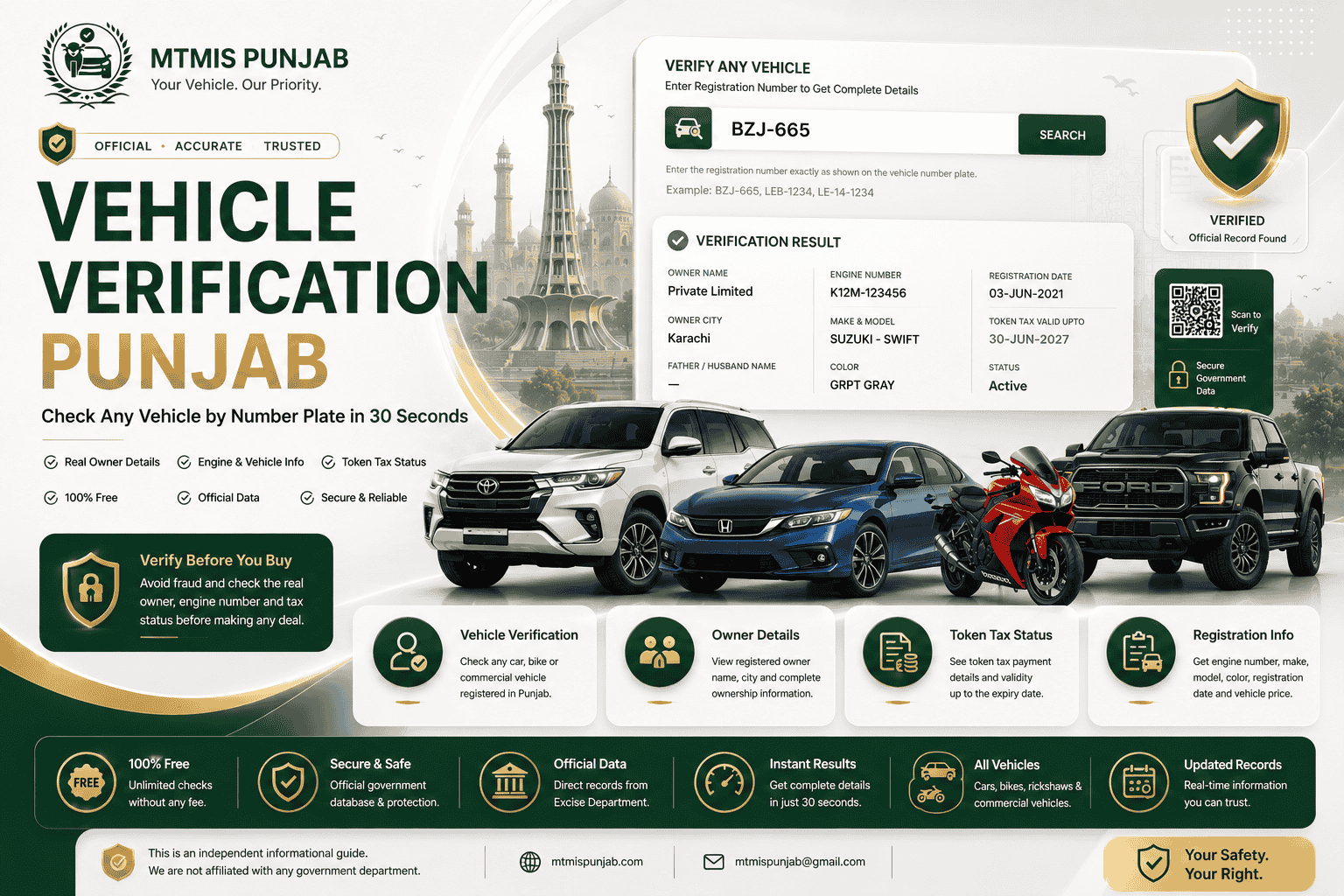
How to Verify a Vehicle Online (Step by Step)
No account, no fee, no documents — just the number plate. Here is the full process:
- Click the verification card above. It opens the official MTMIS Punjab portal, where the records live.
- Type the registration number exactly as printed on the plate — for example, BZJ-665 or LEB-1234.
- Complete the captcha. It exists to block automated scraping, so every search needs one.
- Press Search. The full record appears on one page within seconds.
- Screenshot the result if the check matters — before paying token money, a dated record of what the system showed can settle any later dispute.
Number Plate Formats: Why Searches Fail
Most "vehicle not found" errors are typing problems, not missing records. Punjab has issued several plate series over the years, and the database is strict about format. Therefore, work through these variations before giving up:
- Three-letter series: BZJ-665, LEB-1234, GAA-123 — try with the dash first, then without.
- Letter-year series: LE-14-1234, where the middle digits are the registration year. Include the year segment; searches often fail without it.
- Older two-letter series: LXX-786 and similar still exist in the database.
- Motorcycles: usually the same three-letter pattern; smaller districts sometimes use the series printed in the documents rather than the plate.
Every Field on the Verification Result, Explained
This is where most guides stop and ours begins. We recently verified a 2021 Suzuki Swift registered in Punjab, and the portal returned every field below. Here is what each one actually tells you — including the details that confuse even experienced buyers.
Registration Number
Displayed at the top right, this confirms which vehicle the record belongs to. Always match it against the physical plate AND the documents in the seller’s hand. If the seller’s file shows a different number, you are looking at the wrong vehicle’s paperwork — stop there.
Owners Details: Person or Company
Three fields sit here: owner name, father’s or husband’s name, and owner city. With an individual owner, check all three against the seller’s CNIC — names repeat constantly in Pakistan, so the parentage line is your second identity lock.
Our example showed something different, however: the owner was a company — a private limited firm — and the father/husband field was blank. That is normal. Company-owned vehicles list the business name, and the parentage field stays empty because companies have no parents. If you are buying a company-owned vehicle, the person selling it must produce written authorization from the company (typically a board resolution or authority letter) — an individual’s CNIC alone proves nothing about their right to sell it.
One more surprise from this record: the owner city read Karachi, on a Punjab-registered vehicle. This confuses many users, so let’s be precise. The owner city shows the city in the owner’s recorded address — not where the vehicle was registered. A Punjab plate with a Karachi-based owner is perfectly legal; companies and individuals register vehicles where they operate, not only where they live.
Latest Payment Details: The Money Trail
This block shows the date, amount, and type of the most recent transaction on the record. Our example read: 03-Jul-2026, Rs. 25,677, type TRANSFER OF OWNERSHIP — meaning a transfer had just been paid for days before our check.
Read the payment type first. It will say NEW REGISTRATION, TOKEN TAX, or TRANSFER OF OWNERSHIP, and it tells you the last official event in the vehicle’s life. Then read the date: a recent date means an active, maintained record, while a years-old date on an annual-tax vehicle usually signals unpaid dues — which become the next owner’s bill.
Vehicle Details: Match Everything Physically
- Engine number. Match it against the engraving on the engine itself, not just the papers. A ground-off or different number ends the deal immediately.
- Make name. Brand and model together — SUZUKI – SWIFT in our example.
- Registration date vs. year of manufacture. Our Swift showed 2021 for both — a clean match. A gap between them (built 2024, registered 2026) is legal but worth a question, and it affects resale value.
- Vehicle price. The declared value at registration — Rs. 2,260,000 for this Swift. It is the tax-calculation figure, usually below market price, so never treat it as a valuation.
- Color. Recorded as manufacturer paint codes, sometimes cryptic — GRPT GRAY here simply means a factory gray shade. If the record says gray and the car is now blue, it has been repainted; ask why before assuming the worst.
Token: The Field Everyone Misreads
The Token field shows your tax position, and it speaks two different languages. On motorcycles and cars up to 1000cc it says "Life Time", because those vehicles pay a one-time lifetime token at registration — settled forever.
On larger vehicles it shows a date instead. Our Swift displayed 2027-06-30, which means the annual token tax is paid up to 30 June 2027 — the end of the current fiscal year. A future date is exactly what you want to see. Conversely, a date in the past means unpaid years are sitting on the record, and outstanding token tax follows the vehicle to its next owner. Check the current rates on our token tax page before you negotiate, because those dues belong in the price discussion.
The Application Status Block
At the bottom of the result, you may see an application type and status — our example showed TRANSFER OF OWNERSHIP: IN PROGRESS. For a buyer, this block is pure gold: it tells you paperwork is currently moving on this vehicle. An in-progress transfer means ownership is mid-change; wait for it to complete and re-verify before any payment, so the record you rely on is the final one.
Red Flags: When to Walk Away
Verification only protects you if you act on what it shows. These are the results that should stop a deal:
- Engine number mismatch between the screen and the vehicle — the strongest signal of tampering or a wrong-record situation. No explanation makes this acceptable.
- Seller’s CNIC doesn’t match the owner field — you are buying from someone who doesn’t own it. Open-letter chains create this; insist on meeting the recorded owner or completing a proper transfer.
- Company owner, individual seller, no authorization — without a board resolution or authority letter, that sale cannot legally complete.
- Token date in the past — not a deal-breaker, but every unpaid year is your bill after purchase. Get the amount and subtract it from the price.
- Transfer in progress — never pay against a record that is mid-change. Wait, then re-verify.
Check a Vehicle by SMS (Code 8785)
No internet at the Sunday bazaar? Send the registration number by SMS to 8785, and the reply carries the vehicle’s basic record within a minute or two. Standard SMS charges apply. The SMS route works well as a quick first filter; for the complete record with payment details, the online verification above remains the better tool.
Common Problems and Quick Fixes
- "Vehicle not found." Try the three format variations first — with dash, without, and with the year segment. If nothing works, the vehicle is probably registered in another province: Islamabad, Sindh, KPK, and Balochistan all run separate systems.
- The record shows a previous owner. The last sale never completed at the Excise office — the classic open-letter situation. Only a formal, biometric-verified transfer updates the name.
- Brand-new vehicle not appearing. Fresh registrations take some days to reflect; check again after a week before worrying.
- Details in your own record are wrong. Corrections happen at your district Excise office with original documents — the public portal cannot edit records.
- Portal slow or down. Traffic spikes near tax deadlines are normal; use SMS 8785 or try off-peak hours — early mornings work best in our experience.
Frequently Asked Questions
How can I check who owns a vehicle in Punjab?
Enter the registration number on the MTMIS Punjab portal and complete the captcha. The result shows the registered owner — a person with parentage details, or a company name — along with the owner’s city, vehicle details, and tax status.
Is vehicle verification in Punjab free?
Yes, completely. Online verification is free with unlimited searches and no account required. Only the SMS method carries your carrier’s standard message charge, and official transactions such as transfers involve their normal government fees.
What does the Token date on the result mean?
It shows how far the annual token tax is paid — 2027-06-30 means paid through 30 June 2027. A future date is healthy; a past date means unpaid dues that transfer to the next owner. "Life Time" appears instead on motorcycles and cars up to 1000cc.
Why does a Punjab vehicle show an owner city outside Punjab?
The owner city reflects the owner’s recorded address, not the place of registration. A Karachi-based person or company can legally own a Punjab-registered vehicle, so an out-of-province city is normal and not a red flag by itself.
The owner is a company — can I still buy the vehicle?
Yes, but only from someone authorized to sell it. Ask for the company’s board resolution or authority letter naming the person handling the sale, and complete a formal transfer. An individual’s CNIC alone proves nothing for a company-owned vehicle.
Can I verify a vehicle by chassis number or CNIC?
No. Public verification works by registration number only. Chassis-based and CNIC-based lookups are not available on the public portal, which protects owners’ privacy while still letting buyers confirm any specific vehicle.
Does this check work for Islamabad or Karachi-registered vehicles?
No. The Punjab system covers Punjab-registered vehicles only. Islamabad, Sindh, KPK, and Balochistan maintain their own databases, so a genuine plate returning "not found" here is most often another province’s registration.
What is the SMS code for vehicle verification in Punjab?
Send the registration number to 8785 and the reply brings the vehicle’s basic details. Standard SMS charges apply, which makes it the handiest option when you are standing in a bazaar without internet.
Verify First. Negotiate Second.
Every field on that result page exists to protect you — the owner block confirms who you are really dealing with, the payment trail exposes hidden dues, and the token date puts a number on them. Run the check before the test drive, before the token money, and once more after the transfer completes. When the result raises a question, our guides on token tax rates and smart card download have the next answer ready.
Have a question or found outdated info? Contact Us — or learn more About Us and how we keep this guide accurate.